
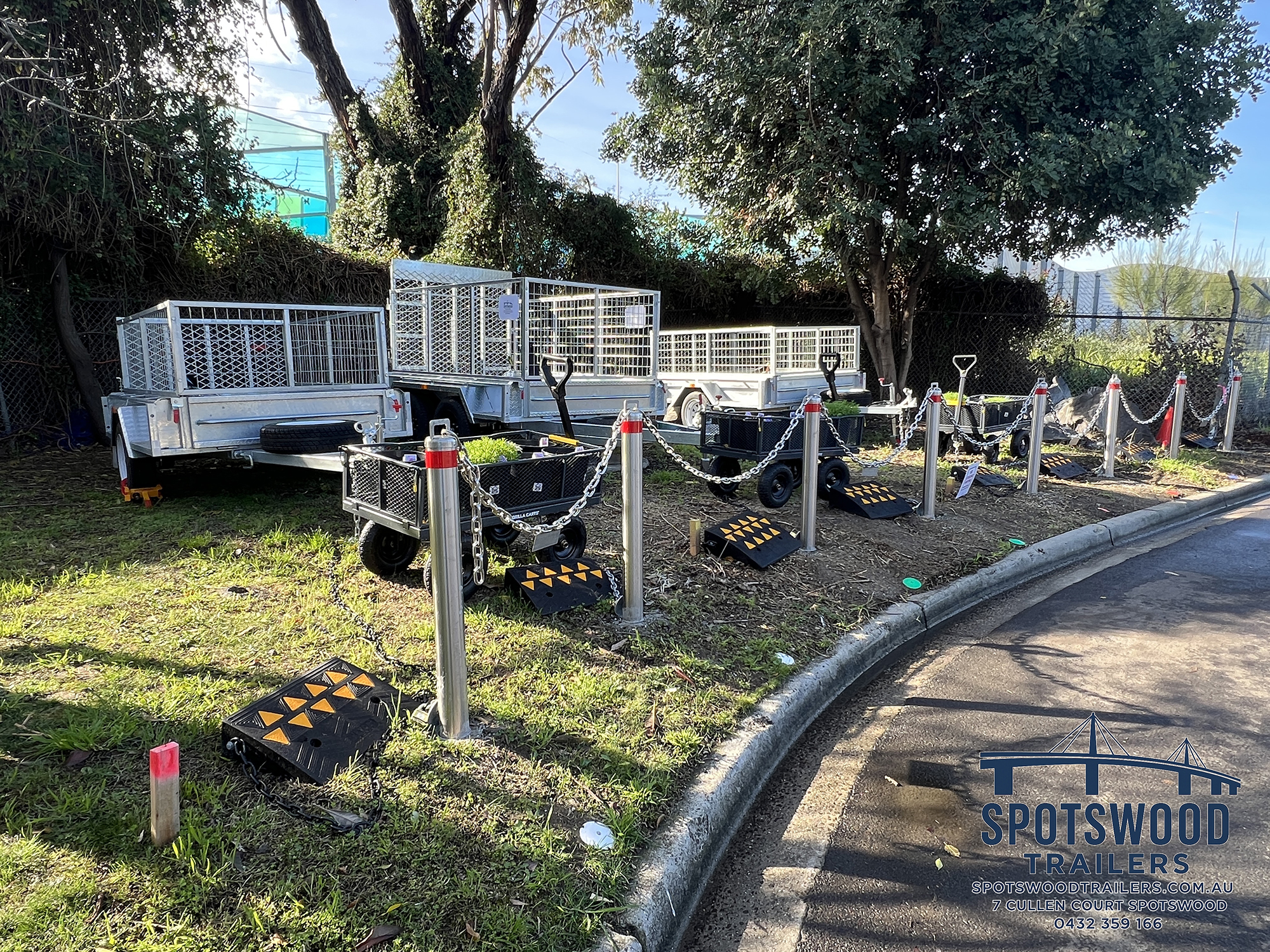
Much has been said in planning discourse about "amenity" —that elusive, often subjective quality used by councils to assess whether a site contributes positively to its surroundings. But what happens when amenity collides head-on with a zoning classification that was never meant to exist in the first place?
Welcome to 7 Cullen Court, Spotswood: a small, 112-square-metre parcel of land that is zoned Transport Zone 2 (TRZ2)—the same classification used for roads, freeway verges and contractor depots. If that zoning is correct (which, as I’ve shown, it is legally not), then the look of my site is not just acceptable. It's perfect.
Let’s pause to admire what TRZ2 zoning typically produces across Victoria:
It's utilitarian. It's industrial. And crucially — it is not required to be beautiful.
So let’s apply that standard, fairly and consistently, to my site.
At 7 Cullen Court, you’ll find:
It's clean, orderly, transport-specific, and—above all—reversible within 30 minutes. In other words: a textbook TRZ2 site, but with far more amenity than most Department of Transport run examples.
Planning enforcement relies on the logical flow of zoning → permitted uses → expected amenity. But what if the zoning is misapplied?
Let’s follow the logic assuming TRZ2 is valid:
If Council or the Department of Transport considers my site an eyesore, then they are criticising it for being too accurate a reflection of TRZ2 standards.
This is not a failure of compliance. It is a triumph of planning fidelity.
But of course, the punchline is this:
The zoning isn't correct.
My site is privately owned land, alienated from the Crown under Instrument H323270, following a 1978 Executive Council order discontinuing Cullen Street for transport purposes. It is no longer Crown land, no longer transport land, and should not be zoned TRZ2.
Which means:
The amenity "problem", therefore, is not the result of my site activation.
It's the result of a zoning segmentation fault —a null reference in Victoria’s planning code.
You cannot have it both ways.
Either the TRZ2 zoning is correct, and my site’s look is entirely compatible with its intended purpose.
Or the TRZ2 zoning is invalid, and the visual incongruity it creates becomes Exhibit A in the case for rezoning.
Either way, I am not at fault. The planning system is.
If my trailers are too ugly, then the zoning is too. If my chains and carts are out of place, then so is the classification. And if my lawful activation under Section 6(3) of the Planning and Environment Act 1987 makes regulators uncomfortable, then perhaps it’s time to un-zone the contradiction.
Download the video here to watch offline.
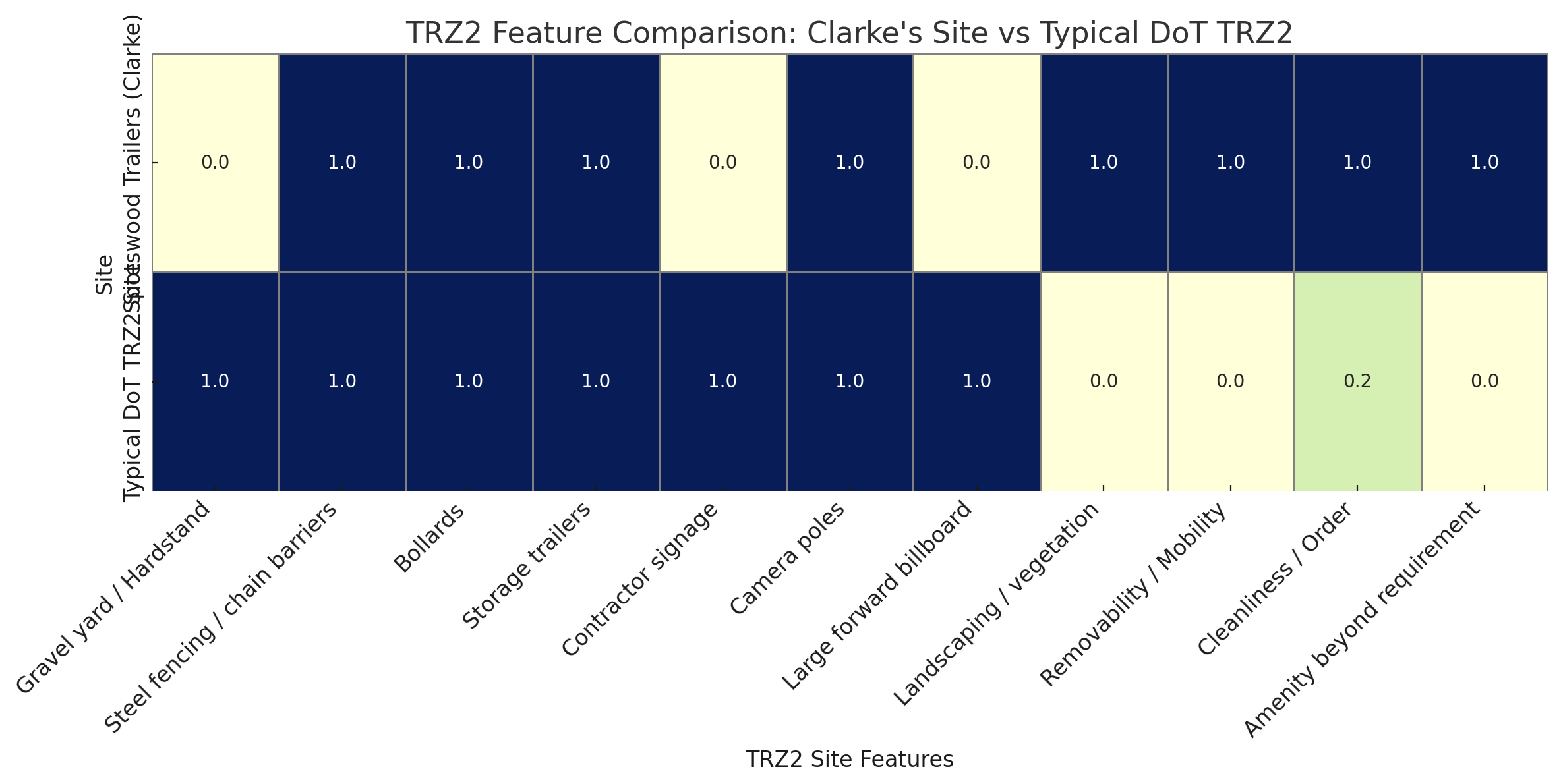
This table compares Spotswood Trailers (Clarke) with a Typical Department of Transport TRZ2 site. Scoring uses a 0–1 scale:
| TRZ2 Site Feature | Clarke's Score | DoT Score | Difference |
|---|---|---|---|
| Gravel yard / Hardstand | 0.0 | 1.0 | -1.0 |
| Steel fencing / chain barriers | 1.0 | 1.0 | 0.0 |
| Bollards | 1.0 | 1.0 | 0.0 |
| Storage trailers | 1.0 | 1.0 | 0.0 |
| Contractor signage | 0.0 | 1.0 | -1.0 |
| Camera poles | 1.0 | 1.0 | 0.0 |
| Large freeway facing LED billboard | 0.0 | 1.0 | -1.0 |
| Landscaping / vegetation | 1.0 | 0.0 | 1.0 |
| Removability / Mobility | 1.0 | 0.0 | 1.0 |
| Cleanliness / Order | 1.0 | 0.2 | 0.8 |
| Amenity beyond requirement | 1.0 | 0.0 | 1.0 |
| TOTAL | 8.0 | 7.2 | +0.8 |
| AVERAGE | 0.73 | 0.65 | +0.08 |
Interpretation: Despite being subject to the same zoning, Spotswood Trailers achieves a higher total and average compliance score than a typical DoT TRZ2 site. The gap is especially significant in:
Any critique of the site’s appearance or functionality becomes a critique of the very TRZ2 standards the Department of Transport enforces on its own land.
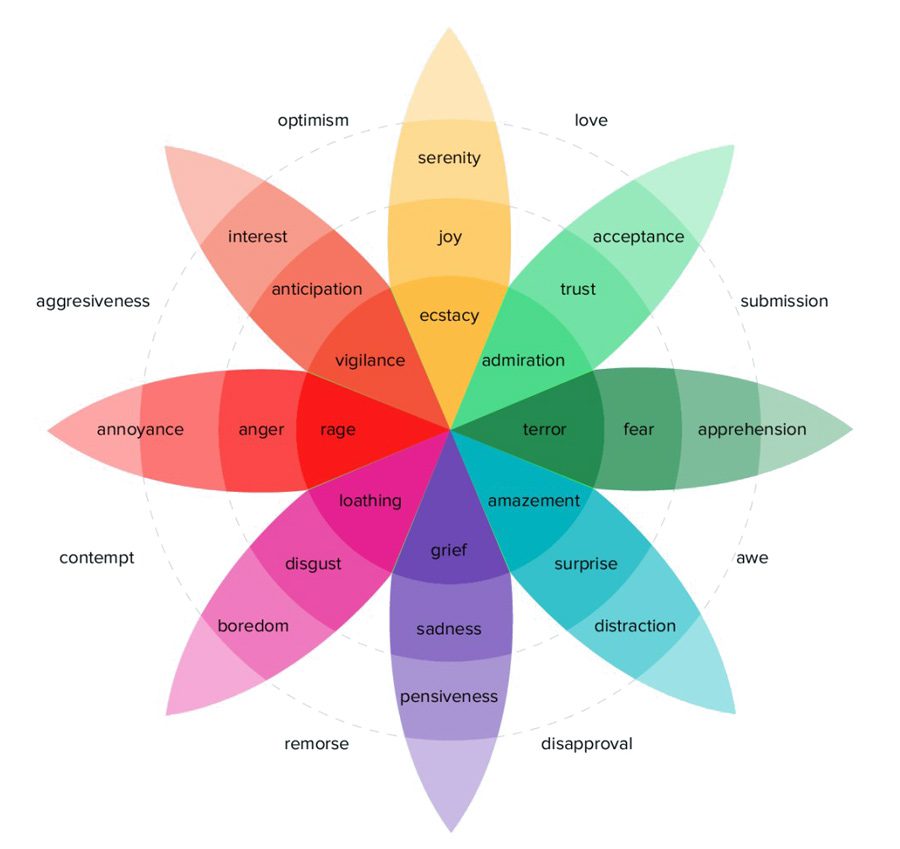
Using Plutchik’s Wheel of Emotions, the following analysis breaks down the likely feelings of a neighbour or first-time visitor to the Spotswood Trailers site, based on the photo shown.
| Primary Emotion | Reaction | Triggered By |
|---|---|---|
| Admiration | Respect, validation | Symmetry, bollards, trailer placement |
| Trust | Safety, predictability | Stainless steel, locks, clean perimeters |
| Anticipation | Curiosity, intrigue | Branding, signage, unexpected order in TRZ2 |
| Joy | Serenity, satisfaction | Natural surface, controlled greenery, order |
My TRZ2 site doesn’t just comply legally — it communicates safety, care, and professionalism through design. It evokes admiration, trust, anticipation, and joy — four of the most socially constructive emotions in Plutchik’s framework. In doing so, it reverses every negative emotional expectation the public holds about transport-zoned land.
⚠️ And yet… there’s a moment — a “WTF moment” — that some visitors experience when they first arrive.
That moment isn’t caused by the trailers.
It’s caused by a misalignment in their mental model: they don’t know the land is zoned Transport Zone 2 (TRZ2).
They expect residential charm, or disused space, or government inaction. What they find instead is
flawless execution of a zoning classification they didn’t even know existed.
Once they understand the truth — that the site is transport-zoned, legally activated, and planned down to the millimetre — the dissonance fades. Admiration replaces confusion. The site begins to make sense. And in that moment, the system itself is revealed.
This is not non-compliance. It’s a mirror.
And what it reflects is everything TRZ2 could be — if it were maintained with clarity, pride, and intent.
To objectively evaluate amenity across Transport Zone 2 (TRZ2) sites, we ran a Monte Carlo simulation comparing Spotswood Trailers at 7 Cullen Court against 10,000 simulated Department of Transport TRZ2 sites. Each simulation varied feature presence based on real-world probabilities (e.g. gravel yard presence, landscaping absence, etc.).
Features like cleanliness, landscaping, reversibility, and order were modeled using probability distributions. Clarke’s site used fixed scores derived from physical inspection and documented site features.
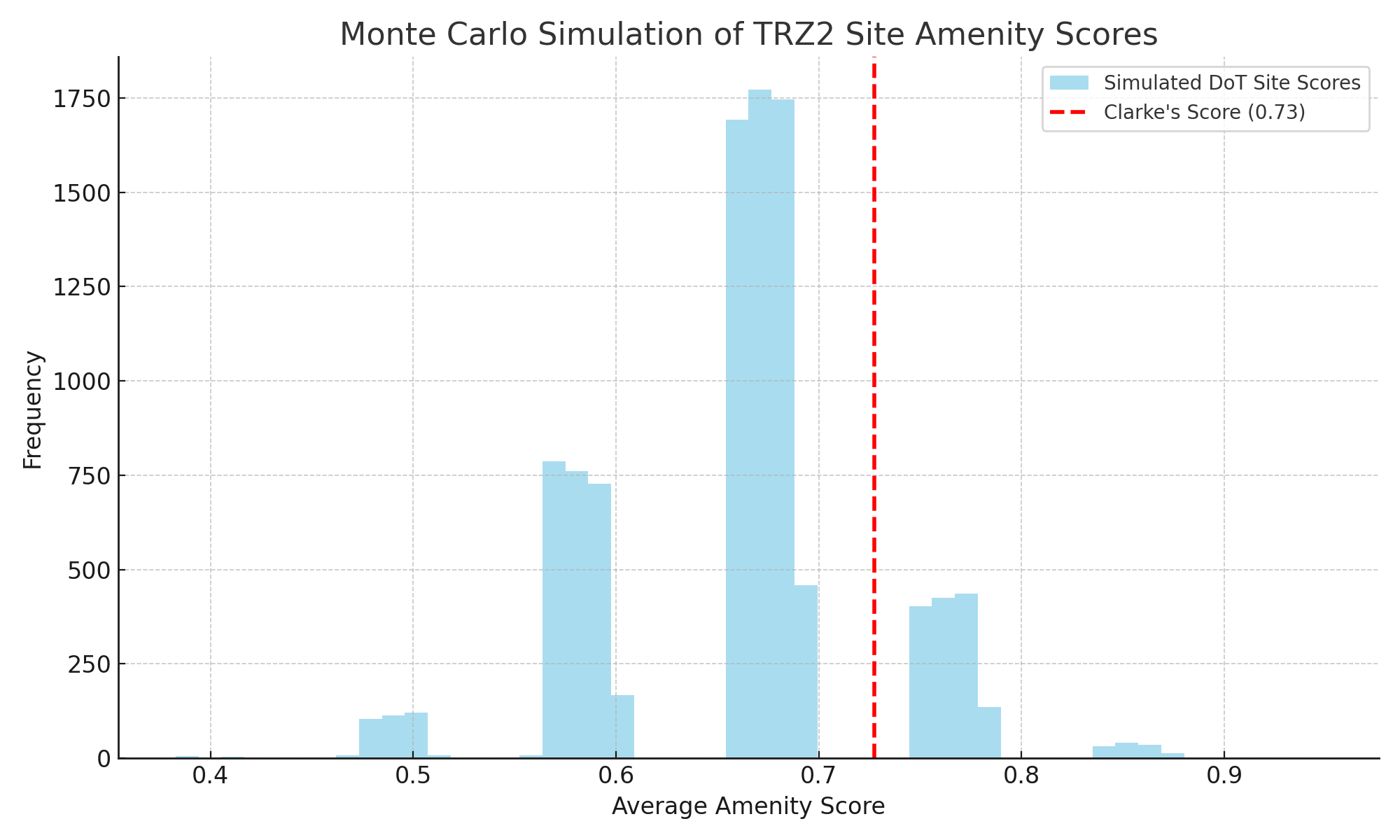
Clarke’s average site score (0.73) outperforms 92.8% of simulated Department of Transport TRZ2 sites.
Key Findings:
The conclusion is simple: if TRZ2 amenity matters, then 7 Cullen Court sets the standard. And if amenity is irrelevant to TRZ2, then the site cannot be faulted for matching the zoning’s utilitarian character.
"Amenity isn’t just visual — it’s statistical. And the numbers tell a very clear story."
Clarke’s TRZ2 site outperforms 92.8% of simulated Department of Transport sites. Amenity is not just subjective—it’s statistical.